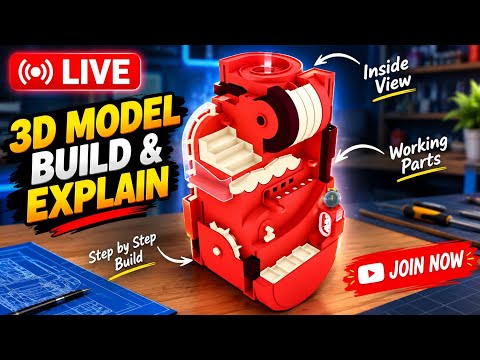
Have you ever wondered how complex machines go from a simple concept to a fully functional digital replica? The world of 3D modeling is more than just creating static shapes; it is an intricate blend of artistry and mechanical engineering. In our latest deep-dive session, we explored the fascinating process of building a model from the ground up, focusing on the mechanics that make every gear and joint move in harmony.
The Foundations of a Great Build
Before you start placing vertices or extruding faces, you need a solid plan. High-quality 3D modeling requires a deep understanding of proportions and spatial relationships. Whether you are using professional software like Fusion 360 or creative suites like Blender, the workflow remains consistent: start with a rough "block-out" to establish scale, and then progressively refine the geometry. During our live build, we demonstrated how starting with simple primitives allows you to maintain control over the complex topology that follows.
Understanding Working Parts and Mechanics
What truly sets a professional model apart is the focus on "Working Parts." It is one thing to make an object look realistic, but it is an entirely different challenge to design components that interact logically. We broke down the specific logic behind pivots, tolerances, and structural integrity. By treating your digital project like a real-world prototype, you elevate your 3D modeling skills to a professional level, ensuring that every screw, lever, and piston serves a functional purpose within the assembly.
Precision and Optimization
Precision is the bridge between a digital hobby and professional engineering. During the step-by-step explanation, we highlighted the importance of measurement accuracy and clean topology. If your parts are even a fraction off, the entire assembly can fail once you reach the animation or 3D printing stage. We also explored techniques for troubleshooting common mesh errors and optimizing your file for better software performance.
Conclusion
Building a functional 3D model is a rewarding journey that challenges your creativity and your logic. By mastering these step-by-step techniques, you are not just creating digital art—you are building complex systems that can be used for everything from video games to industrial prototypes. Dive into the details, embrace the complexity, and start building your next masterpiece today.


