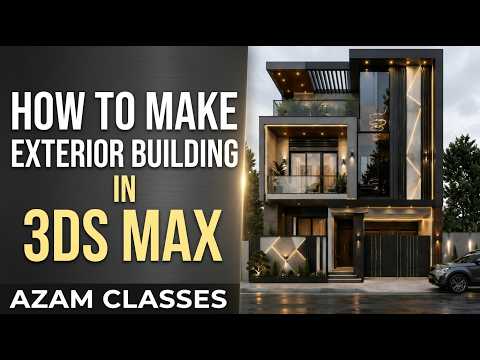
The world of architectural visualization is more competitive than ever, and the ability to transform a flat floor plan into a hyper-realistic 3D environment is a vital skill for any designer. If you have ever wondered how professional artists create those stunning, sleek skyscrapers and residential masterpieces, it all begins with a solid foundation. In this first installment of our comprehensive guide, we delve into the essential techniques for modeling and preparing a modern building exterior for high-end production.
Building a Precise Architectural Foundation
Creating a photorealistic exterior starts with accuracy. Before you even touch the rendering settings, your geometry must be flawless. Modern architecture is defined by clean lines, expansive glass surfaces, and a mix of organic and industrial materials.
In this phase, we focus on establishing the primary structure using 3ds Max’s robust poly-modeling tools. By paying close attention to real-world scales and proportions, you ensure that the environment feels grounded and believable. Whether you are working on a commercial office or a luxury villa, the secret lies in the details—adding slight chamfers to edges and ensuring window frames are modeled with depth can drastically improve the final quality of your 3ds Max rendering.
Optimizing Your Scene for Realism
Once the primary structure is in place, the focus shifts toward lighting and material application. To achieve that coveted "hyper-realistic" look, you must understand how light interacts with different surfaces. Modern buildings often feature complex reflections; therefore, setting up your environment properly is crucial.
During the initial setup, many artists struggle with balancing render times and visual fidelity. By refining your workflow for 3ds Max rendering, you can utilize global illumination and physical cameras to mimic the behavior of real-world photography. This Part 1 guide ensures that your scene is light-efficient and ready for the advanced texturing stages that follow.
Why Quality Modeling Matters
You might have the best textures in the world, but if the underlying model is poorly constructed, the final output will suffer. High-quality visualization is about storytelling. You aren't just showing a building; you are showing a lifestyle. By mastering these foundational modeling techniques, you set the stage for a professional-grade 3ds Max rendering that will impress clients and elevate your portfolio.
Stay tuned for Part 2, where we will dive deeper into advanced material creation, landscape integration, and final post-processing secrets!


