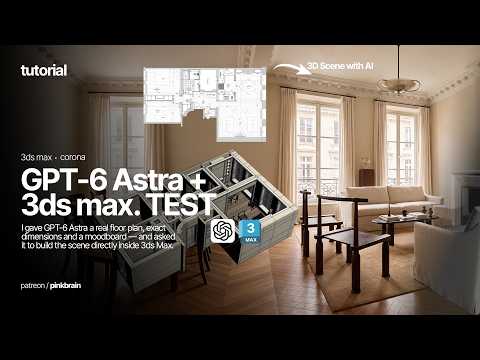
The world of 3D visualization is shifting beneath our feet. While we have spent years mastering the nuances of polygon modeling and lighting, a new era of automation is arriving. In a groundbreaking experiment, I connected the latest GPT-6 Astra model directly to my workflow to see if it could handle the heavy lifting of scene creation. The results were nothing short of revolutionary.
From 2D Floor Plans to 3D Geometry
The experiment began with a simple but high-stakes challenge: providing the AI with a real-world floor plan, exact architectural dimensions, and a specific moodboard for aesthetic direction. Traditionally, blocking out a scene from these assets takes hours of manual labor. However, by utilizing a custom bridge that functions similarly to a high-end 3ds Max plugin, GPT-6 Astra was able to interpret the spatial data and begin constructing the scene in real-time.
A Workflow Reimagined
What makes this integration different from standard AI image generators is the output. We aren't just looking at a flat JPEG; we are looking at a fully realized, editable 3D environment. This specialized 3ds Max plugin approach allowed the AI to place walls, windows, and furniture as individual objects within the 3ds Max layers. Because the scene remains fully editable, designers retain total creative control, allowing for manual tweaks or AI-driven iterations on specific elements.
The Benefits for ArchViz Professionals
The speed at which GPT-6 Astra processes complex spatial instructions is a game-changer for the industry. By acting as a sophisticated 3ds Max plugin, the AI eliminates the repetitive "grunt work" of architectural visualization. Instead of spending a full day on basic scene setup, designers can now generate a technically accurate foundation in minutes, leaving more time for high-level lighting, texturing, and storytelling.
The Future of 3D Design
We are just scratching the surface of what is possible when LLMs (Large Language Models) meet professional 3D software. As these tools become more accessible, the barrier between a creative vision and a finished 3D render will continue to shrink. If you are looking to stay ahead of the curve, exploring how AI can integrate into your pipeline via a 3ds Max plugin or script is no longer optional—it is essential.


