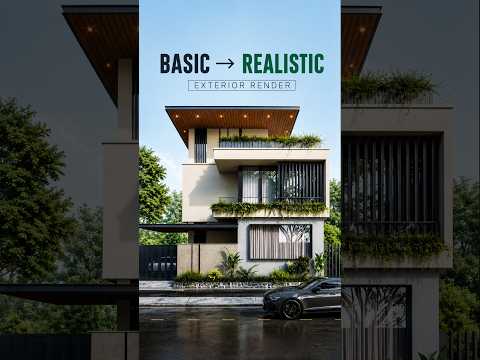
Creating convincing architectural visualizations often comes down to the smallest details. A basic exterior render can quickly look flat, lifeless, or amateurish if key elements aren't dialed in correctly. Fortunately, turning a plain 3D scene into a stunning, photorealistic environment doesn't require rebuilding your project from scratch. By focusing on camera composition, lighting, materials, and landscaping, you can dramatically elevate your architectural workflow in 3ds Max.
1. Optimize Your Camera Angles and Composition
The camera setup is your audience's doorway into the project. Standard eye-level or default perspectives can make architectural designs feel generic. Experiment with dynamic camera angles, adjust the focal length to establish proper depth, and ensure vertical tilt corrections are applied to keep vertical lines straight. A well-composed shot guides the viewer's eye and immediately gives the rendering a polished, professional feel.
2. Refine Lighting and Material Realism
Lighting and shaders do the heavy lifting when it comes to visual depth. Direct, uniform lighting often strips away detail, whereas realistic environment maps (HDRIs) introduce natural color variations and soft ambient reflections. Pair your lighting setup with high-resolution PBR (Physically Based Rendering) materials. Tweaking rough surfaces, adding subtle bump maps, and adjusting reflection glossiness in 3ds Max will give your exterior walls, glass, and pavements the realistic texture they need.
3. Integrate Organic Landscaping and Environment Details
Even the best-lit building will look out of place without natural surroundings. Adding varied greenery—such as realistic trees, shrubs, grass patches, and subtle environment props—breathes life into the scene. Pay close attention to how light filters through foliage and how shadows cast across the landscape, blending soft organic elements with hard architectural lines to ground the structure naturally.
Conclusion
A few strategic adjustments to your composition, lighting setup, materials, and foliage can completely transform a basic render into a captivating masterpiece. With the powerful toolset available in 3ds Max, taking your exterior architectural renders from simple to photorealistic is an achievable goal for any 3D artist. Start experimenting with these core techniques on your next project to see immediate results!


