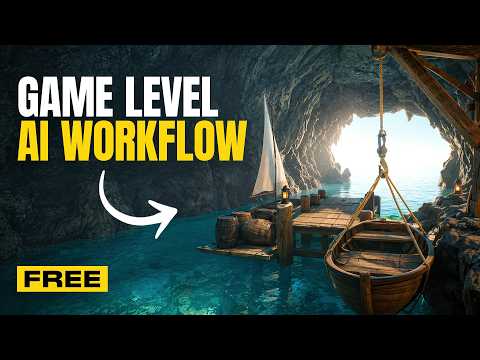
Building an immersive game environment requires more than just compelling characters—it demands detailed, cohesive levels that pull players into another world. Traditionally, populating an entire game scene meant spending hundreds of hours crafting individual props, textures, and structural elements from scratch. Today, the rise of generative AI tools is completely changing the landscape of level design. By combining modern AI mesh generation with custom 3ds Max game assets, creators can build rich, fully realized game environments in a fraction of the time.
Streamlining the Workflow with AI Mesh Generation
The primary bottleneck in world-building is prop creation. From environmental debris and rocks to intricate architectural details, populating a level requires endless asset iteration. Advanced 3D AI tools allow developers to convert simple text prompts or 2D concept art into textured 3D models within seconds.
Rather than starting every object from a blank canvas, you can quickly generate base models for secondary props, foliage, or background elements. Once generated, these assets can easily be imported into your primary 3D software to clean up topology, adjust UVs, and integrate seamlessly alongside your core 3ds Max game assets.
Optimizing and Assembling Your Game Level
While AI tools excel at rapid asset generation, professional 3D software remains essential for scene composition, lighting, and performance optimization. Here is how a hybrid AI-to-3D workflow elevates your project:
- Rapid Prototyping: Block out your level layout quickly using AI-generated meshes to test scale, sightlines, and player flow.
- Refinement and Retopology: Bring generated models into 3ds Max to optimize vertex counts, clean up geometry, and ensure smooth game engine performance.
- Cohesive World-Building: Mix high-detail 3ds Max game assets for focal points with AI-generated background props to maintain visual fidelity without slowing down development.
The Future of Game Development
Integrating AI into your 3D production pipeline isn’t about replacing artistic vision—it is about removing tedious tasks so you can focus on creativity and mechanics. Whether you are an indie developer working on a tight budget or an experienced environment artist looking to speed up world-building, combining free AI modeling tools with traditional asset workflows opens up unprecedented possibilities for modern game production.


